
Evaluating a Lake Travis Acreage Compound
July 16, 2026
July 16, 2026
What does a true private compound near Lake Travis actually require? It takes more than a beautiful view and a large homesite. If you are thinking about a legacy property for family, guests, recreation, or long-term flexibility, you need to understand how access, shoreline rights, utilities, and permitting fit together before you commit. That is where smart planning can protect both your lifestyle and your investment. Let’s dive in.
Lake Travis gives buyers a rare mix of water, topography, and privacy potential. The Lower Colorado River Authority says the lake covers 19,044 acres when full, with 363.3 billion gallons of storage at 681 feet above sea level. That scale helps explain why the area can support very different compound concepts, from waterfront estates to view-rich hilltop retreats.
Just as important, much of the shoreline and land beneath the lake surface is privately owned. For a privacy-minded buyer, that can be a major advantage. It also means your plans for frontage, recreation, and improvements depend on title details and LCRA review, not just what looks possible from the shoreline.
Not every private compound near Lake Travis works the same way. The right setup depends on how you want to use the property, how often you expect guests, and how much future flexibility matters to you.
This is the classic vision many buyers picture first. You may be looking for a primary residence, guest casita, pool, outdoor entertaining areas, and a private dock, all tied together on one waterfront homesite.
The appeal is obvious. Your recreation, gathering space, and lake access can all stay on-site, which creates a more self-contained experience. The tradeoff is that shoreline improvements, dock placement, and changing lake levels become central parts of your due diligence.
Some buyers value privacy, views, and land more than direct frontage. A hilltop acreage property can deliver broad Lake Travis views, space for multiple structures, and a strong sense of separation without the complexity that may come with shoreline construction.
This approach often works well if your priority is a quiet family retreat or a multi-structure estate with room to grow. You may give up direct dock access, but you can gain flexibility in layout, privacy buffers, and estate planning.
Another compelling strategy is buying adjacent tracts and holding them as one larger legacy estate. This can create more privacy, more recreation space, and more control over how the property feels and functions.
It may also preserve future options. Travis County treats subdivision as the first step in dividing land for individual sale or development, so legal lot history, access easements, and the timing of any future split should be reviewed before closing, not after.
If your goal is easy boating without the added complexity of a private dock, a marina-oriented property may be the better fit. This setup can make sense when you want a polished lake lifestyle while keeping shoreline construction off your to-do list.
The tradeoff is that your water access is not fully contained within the property itself. Marina rights, slip availability, and long-term use arrangements are separate considerations, so the property may feel less independent than direct waterfront ownership.
Large acreage can be impressive, but privacy is really about control. Before you fall in love with a property, it helps to ask whether the estate functions the way a compound should.
A strong compound candidate usually comes down to a few core questions:
Those details often matter more than raw lot size. A smaller property with clean access and workable utility planning can be more useful than a larger tract with unresolved constraints.
One of the biggest misconceptions buyers have about Lake Travis is that any waterfront property guarantees consistent lake usability. In reality, water levels can shift significantly over time.
LCRA lists Lake Travis as full at 681 feet above sea level, with a historic low of 614.18 feet and a historic high of 710.44 feet. That range is a practical reminder that shoreline usability, dock reach, and boating convenience can change. If daily lake use is central to your plan, this should be part of your front-end analysis.
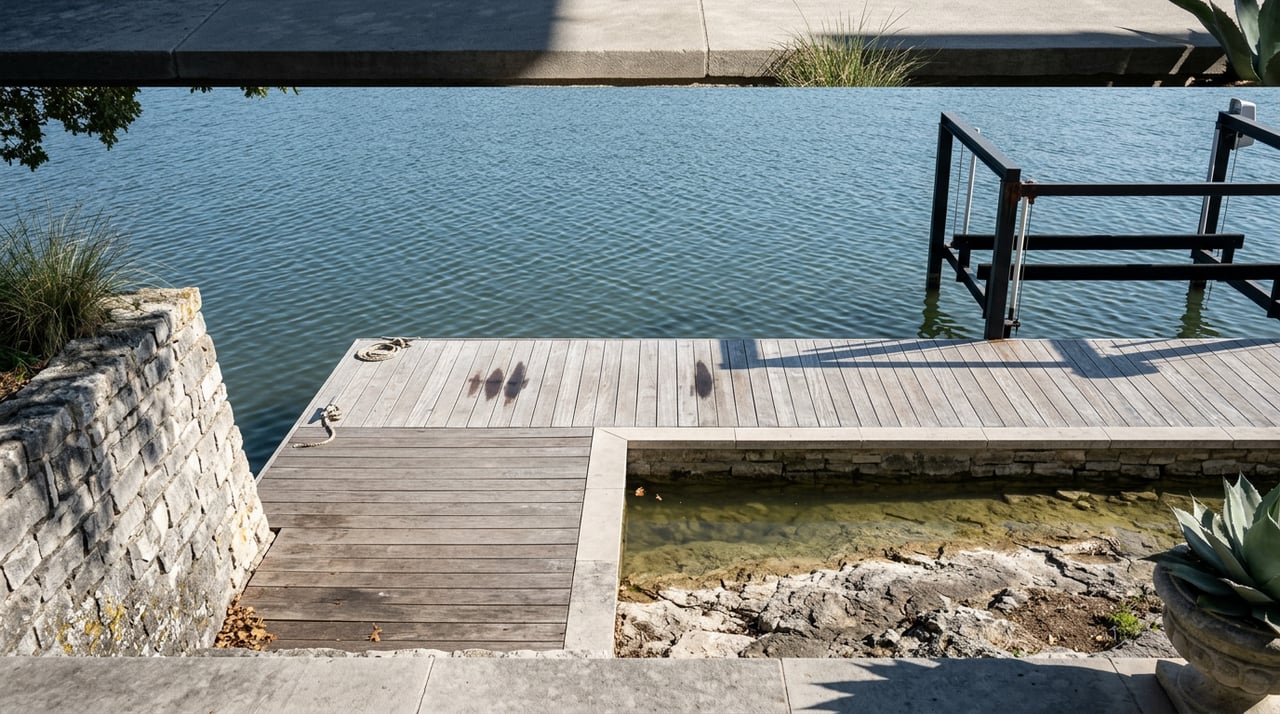
LCRA regulates docks and marinas on Lake Travis. For residential docks, LCRA states that the maximum distance from the shoreline is 100 feet.
That matters because not every waterfront lot will perform the same way when lake levels move. A property that looks ideal during one season may require much closer review of dock placement, water depth, and ongoing usability.
Public access around Lake Travis is uneven. LCRA notes that boat ramps operate at different minimum lake levels, and recreational boating access can be affected during severe flood conditions.
That is why some buyers place real value on marina proximity, private dock rights, or dependable launch access. If boating is central to your lifestyle, it is worth comparing these access paths carefully instead of assuming every waterfront parcel delivers the same experience.
On Lake Travis, a private compound is often as much a permitting project as a design project. In unincorporated Travis County, Development Services oversees permits for development outside city limits and in ETJs, manages floodplain issues, and regulates subdivisions.
The county also states that a basic development permit is required for land development in unincorporated Travis County. If a site sits in an ETJ, municipal concurrence may also be required for certain improvements. That means the path to building can vary from one tract to the next.
Wastewater planning is one of the first things serious buyers should examine. Travis County explains that on-site sewage facilities are used where land is not served by a municipal sewage treatment plant.
The county also notes that properties within 1,000 feet of Lake Travis fall under LCRA septic permitting authority, even though a Travis County development permit is still required. For a multi-structure compound, that division of authority can be very important.
If your compound vision involves acreage, guest houses, outdoor living, and long-term holding, water supply needs a close review. Travis County states that subdivisions using wells must prove adequate groundwater supply through aquifer testing and groundwater availability certification.
The county also says lots supplied by individual water wells must be at least 5 acres. In practice, that makes water strategy a key early filter for larger tract purchases and future division plans.
Compound properties often include long driveways, detached guest structures, motor courts, pool decks, and outdoor entertaining areas. Those elements add up quickly.
Travis County says permanent water-quality controls may be required when a project exceeds 10,000 square feet of impervious cover. If you are planning a highly improved estate, this threshold should be part of the initial design conversation.
Floodplain issues are easy to underestimate when the views are strong and the setting feels elevated. But Travis County makes clear that development permits are required before construction or other development begins in unincorporated areas, including grading, excavation, utility installation, new construction, and substantial improvements.
For a compound buyer, that means floodplain review should happen well before closing. It is much better to confirm how build areas, roads, utility runs, and site improvements interact with county rules than to discover limitations after you own the property.
There is no universal answer. The better choice depends on what you want the property to do for you.
If your vision centers on stepping from the house to the dock, direct waterfront may be worth the added complexity. If your priority is privacy, a broader building envelope, and room for a more flexible estate layout, hilltop acreage may prove more practical.
In many cases, the best decision comes down to this comparison:
| Option | Strengths | Main Considerations |
|---|---|---|
| Direct waterfront | On-site lake access, dock potential, self-contained recreation | Lake-level variability, dock rules, shoreline review |
| Hilltop acreage | More privacy, wider views, flexible estate layout | No direct frontage, separate boating access may be needed |
| Marina-oriented property | Easier boating access without private dock construction | Slip rights and marina use are separate from land ownership |
| Assembled parcels | More control, privacy, and future flexibility | Lot history, easements, and future subdivision review matter |
The strongest compound purchases usually come from matching the property type to your real use case, not chasing a single label.
When a property near Lake Travis looks promising, your next step is disciplined due diligence. The goal is to confirm that the land supports the life you want to create.
A helpful review process often includes:
This is where experienced local guidance becomes valuable. On a property like this, the view may get your attention, but the land planning details are what protect your outcome.
A private compound near Lake Travis is absolutely possible in concept, but the best opportunities are rarely the ones judged by scenery alone. They are the properties where access, utilities, septic, floodplain status, dock rights, and long-term flexibility all align.
For buyers who value privacy, place, and a more strategic acquisition process, Lake Travis can be a compelling setting for a legacy estate. The key is to think like a land planner before you think like a decorator.
If you are exploring a private compound near Lake Travis and want discreet, place-specific guidance, Kody Hall can help you evaluate access, privacy, and property fit with the level of precision these purchases require.
Stay up to date on the latest real estate trends.

Partnering with an acclaimed real estate professional is crucial to navigate the complexities of the high-end market. The luxury sphere requires vast knowledge of private sales and precision-level marketing tactics, all while maintaining client confidentiality throughout the process. Hall Realty Group provides forward-thinking processes that encompass the highest level of attention to detail. For sellers, it's imperative to analyze off-market comparables and exclusive market trends, both of which are not publicly available. In order for a buyer to achieve success, the client must be aware of exclusive listings not broadcast on the open market. These aspects complement our extensive network, directly correlating to the success of our clientele. HRG possesses superior negotiation skills honed through experience in dealing with high-value transactions. Kody understands the art of negotiation in the luxury market, including how to navigate complex offers, handle multiple bidders, and advocate effectively on behalf of their clients. HRG has a deep understanding of the luxury lifestyle and effectively communicates tailored strategies needed for the desired result.