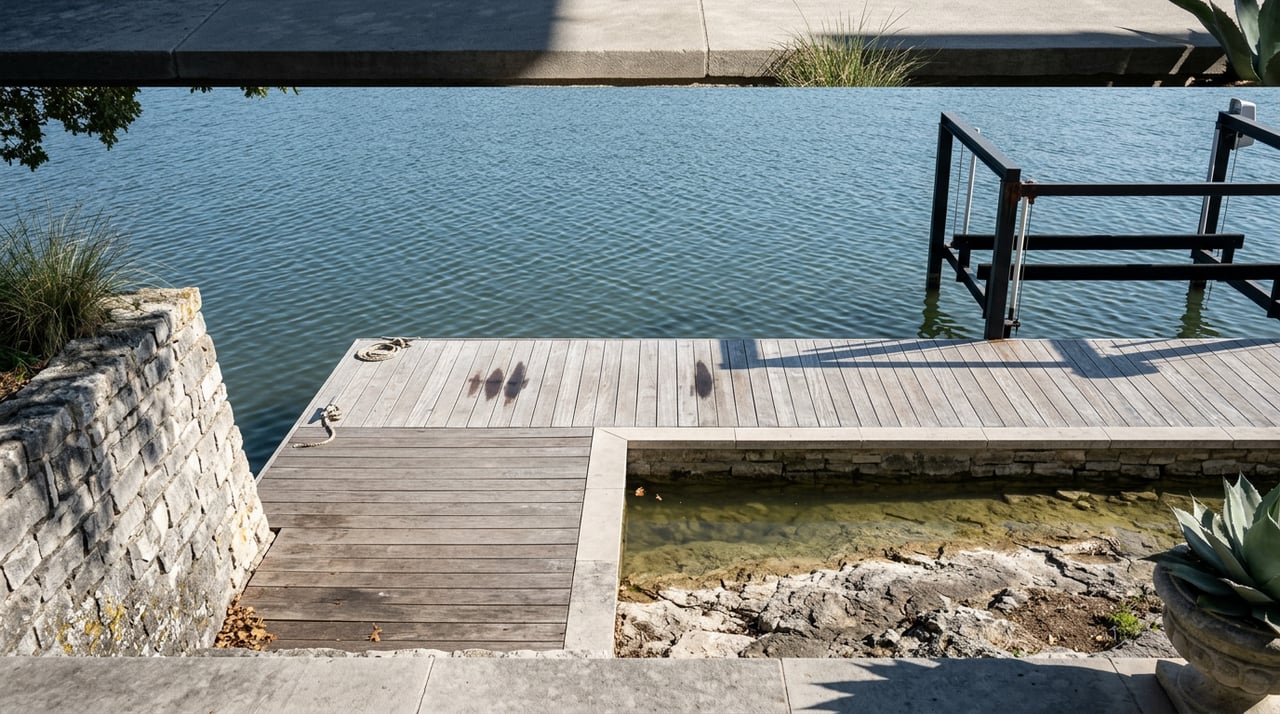
Lake Austin Drawdown Dock Permit Guide for Buyers and Sellers
August 27, 2026
August 27, 2026
If you're under contract on a Lake Austin waterfront property this fall, or thinking about listing one, the lake itself is about to hand you a problem that has nothing to do with your inspection report. Starting October 12, 2026, the Lower Colorado River Authority will lower Lake Austin by about ten feet between Mansfield Dam and Tom Miller Dam, dropping the water level by no more than a foot a day until it settles somewhere between 481.8 and 482.8 feet above mean sea level. It will stay there through November 30, 2026. Public boat ramps close for the duration. Swimming at Emma Long Metropolitan Park is prohibited the entire time.
Most owners will read that as a seasonal inconvenience: boats out of the water, docks a little harder to reach, back to normal once the drawdown ends. That reading misses what actually matters for anyone with money on the table. This drawdown is the one predictable window in the current cycle when the pilings, bulkheads, and retaining walls that sit underwater the other ten months of the year become visible, reachable, and fixable. On a lake where dock status already shows up directly in the sale price, that window is worth more to a seller's bottom line than almost anything else happening in the market right now.
Here's the detail that catches buyers coming from a search on Lake Travis or Lake LBJ off guard: the LCRA says the City of Austin handles dock permits for properties within city limits on Lake Austin.
LCRA still matters on Lake Austin. It manages the lake itself and schedules the drawdowns like this one. For properties within city limits, the actual dock permit, construction review, and safety inspection run through the City of Austin under Land Development Code Article 13, not through LCRA's Highland Lakes dock program. If you or your agent pulls the LCRA dock safety standards expecting them to govern your Lake Austin parcel within city limits, you're reading the wrong rulebook.
That split also means the diligence file looks different depending on jurisdiction within the same shoreline. Properties inside city limits face site plan review, impervious cover limits, and watershed overlays. Some 2026 listings have marketed deannexation as a selling point. Treat it as a title question you verify with a survey and a title commitment, not a line item you take on faith from a listing sheet.
The mechanics of this particular drawdown are worth knowing before you plan around it. The lake drops slowly, about a foot a day, and LCRA expects it will take roughly three weeks to reach the target range once the release begins on October 12. Because water is still moving through the system to meet downstream needs, the upper end of the lake near Mansfield Dam can read higher than the level measured at Tom Miller Dam during the drawdown, so don't assume a uniform ten-foot drop across every cove.
The city is holding a public information session on the drawdown and its permitting requirements on September 9, from 6 to 8 p.m., at the Permitting and Development Center on Wilhelmina Delco Drive. If you own shoreline property and have been putting off a dock or bulkhead repair, that session is the practical place to start, because it's where the LCRA says the city plans to release a dedicated site plan exemption application specifically for minor repairs made during this drawdown window.
This isn't a one-time event in the life of the lake. LCRA periodically lowers Lake Austin to let owners get at structures that are submerged the rest of the year and to manage nuisance vegetation along the shoreline. The pattern repeats. What doesn't repeat on a fixed schedule is the paperwork that should already be sitting in a file somewhere, ready to hand to a buyer's attorney the moment an inspection period opens.
Every Lake Austin seller with a dock should be able to produce the applicable records before a buyer's option period starts, not after:
For properties within city limits, that registration requirement is easy to overlook because it's separate from the construction permit itself. The city adopted it under City Ordinance No. 20140626-113, and a dock can be fully and properly permitted while still being out of compliance simply because the address sign is missing or faded past legibility. It's a small thing to fix and an easy thing for a buyer's inspector to flag.
A dock that gets rebuilt after storm damage deserves its own line of scrutiny.
Here's the part that turns paperwork into money. As of July 2026, Lake Austin waterfront was trading at roughly $597 per square foot, close to double the citywide Austin median of $302 over the same period. At that price level, a permit gap that costs $150,000 to resolve isn't a rounding error on a luxury transaction. It's the equivalent of roughly 250 square feet of home value, gone, because the market is pricing this shoreline by the foot and a defective dock file eats into that math directly.
The top of the market this summer makes the stakes concrete. Current asking prices include a $15 million listing on Edgewater Drive and a $19 million listing on Rockcliff Road, alongside a third property on Westlake Drive being marketed without a public price as a potential record for the city. A two-lot, roughly 4.25-acre waterfront assemblage on Bruton Springs came to market this spring with plans for a new estate, the kind of project where site plan review, environmental review, and dock authorization all have to clear before a shovel goes in the ground.
With around 37 active listings and roughly 18 sales a month on the lake this summer, sellers aren't under pressure to move fast. That gives them room to hold pricing, but it also means a buyer's leverage in negotiation doesn't come from finding a better comp. It comes from finding a gap in the file. A clean title, a current dock registration, and a documented impervious cover budget are the three things that actually move a number during option period on this lake.
For buyers closing during the drawdown window, some things that look alarming are simply normal. Exposed shoreline, a dock sitting higher above the waterline than it did in July, and closed public boat ramps are all expected consequences of a planned ten-foot drop, not signs of a defect. What isn't normal, and what deserves a direct question to the seller, is any dock or bulkhead work being rushed to completion during this window without a permit number attached to it. The exposed lakebed makes shortcuts easier to take and easier to hide once the water returns after the drawdown ends.
For sellers planning to list before spring, this is the two-month stretch to get ahead of the file rather than react to a buyer's inspector finding the gap first. If a bulkhead needs pointing, or a dock needs a permit amendment for something modified without approval years ago, the structure is finally reachable without hiring a marine crew and a barge.
Will the drawdown affect Lake Travis or Lake LBJ too? No. This release is specific to Lake Austin, between Mansfield Dam and Tom Miller Dam. Other Highland Lakes operate independently and aren't part of this schedule.
Can I still use my dock during the drawdown? In many coves, yes, though usability depends on how much depth that specific location loses. Shallow coves on the eastern end of the lake are more likely to become impractical for larger boats during the lowered period than deeper central and western stretches.
If you're weighing a fall closing on Lake Austin, or preparing to list before the water comes back up after November 30, the file matters as much as the facade. Kody Hall works this shoreline closely enough to know which permits tend to go missing and which ones tend to get questioned first. Request Private Access to talk through what your specific dock, cove, and closing date actually require before the option period starts, not after.
This article is general information, not legal, tax or financial advice. Consult a qualified professional about your situation.
Stay up to date on the latest real estate trends.








Partnering with an acclaimed real estate professional is crucial to navigate the complexities of the high-end market. The luxury sphere requires vast knowledge of private sales and precision-level marketing tactics, all while maintaining client confidentiality throughout the process. Hall Realty Group provides forward-thinking processes that encompass the highest level of attention to detail. For sellers, it's imperative to analyze off-market comparables and exclusive market trends, both of which are not publicly available. In order for a buyer to achieve success, the client must be aware of exclusive listings not broadcast on the open market. These aspects complement our extensive network, directly correlating to the success of our clientele. HRG possesses superior negotiation skills honed through experience in dealing with high-value transactions. Kody understands the art of negotiation in the luxury market, including how to navigate complex offers, handle multiple bidders, and advocate effectively on behalf of their clients. HRG has a deep understanding of the luxury lifestyle and effectively communicates tailored strategies needed for the desired result.