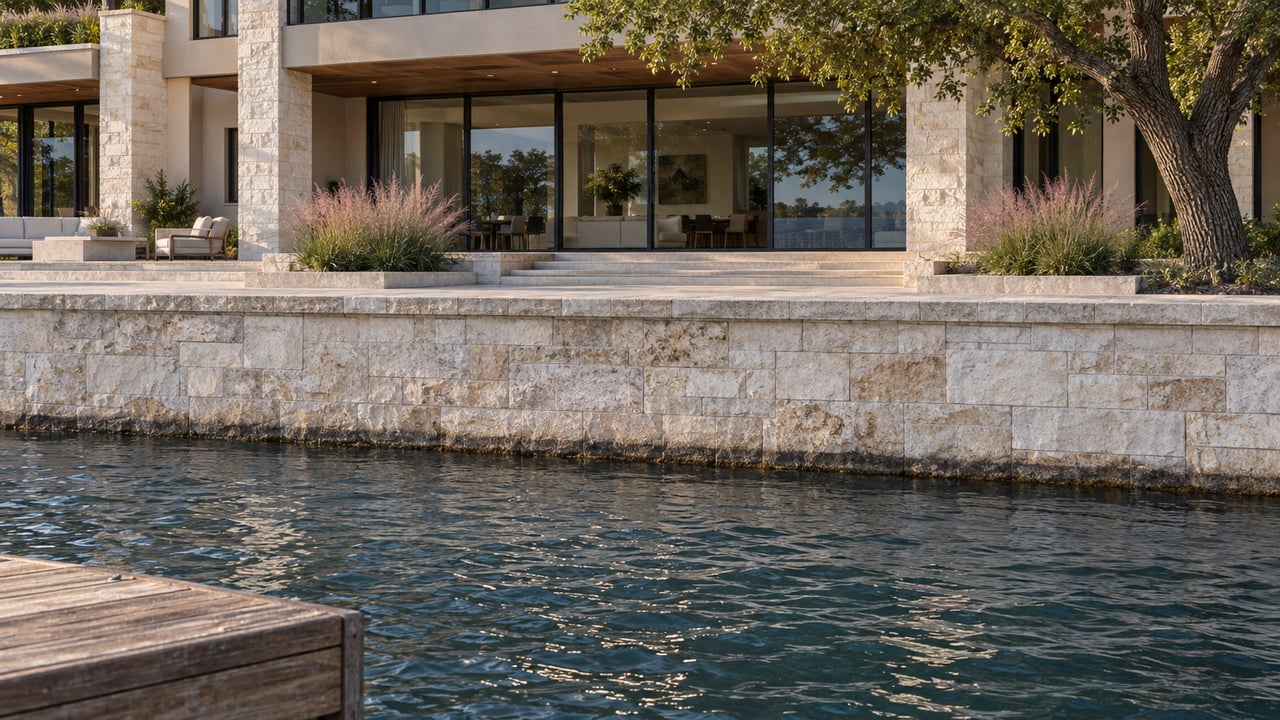
Lake LBJ Waterfront Pricing: Why the Water Sets the Value
October 1, 2026
October 1, 2026
Buyers looking at Lake LBJ ask the same question almost every time: what's the price per square foot out here? It's a fair question. It's also the wrong one, and brokers who work this lake regularly will tell a buyer that before they'll answer it. Two homes with nearly identical floor plans, same era, same finish level, can sit eight hundred thousand dollars apart in asking price. The gap isn't in the drywall. It's in what sits between the back door and the water.
That gap is the actual story of Lake LBJ real estate right now, and it matters more to a buyer comparing neighborhoods than any median price pulled from a portal search.
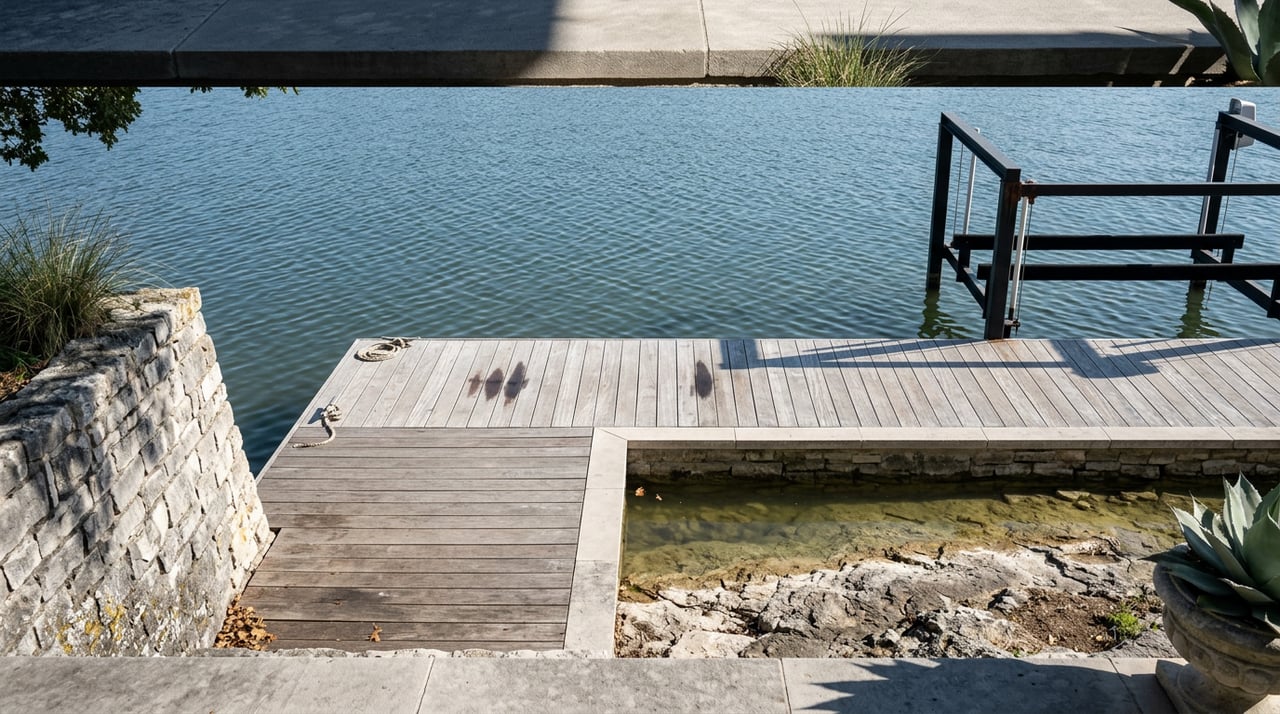
Start with the part of a Lake LBJ transaction that catches people off guard after they've already fallen for a house. Every dock, boathouse, and bulkhead on this lake sits under a permit from the Lower Colorado River Authority, and that permit has to be current and it has to transfer to the new owner at closing. It doesn't automatically follow the sale. A structure without a clean permit history isn't disqualifying, but it stops being the seller's problem and starts being the buyer's the moment the ink dries, unless the contract accounts for it in advance.
This is the kind of detail that never shows up in a listing photo. A dock can look pristine and still carry an expired or nonexistent permit. A buyer who assumes the paperwork matches the concrete is the buyer who finds out the hard way, usually during a delayed closing or a post-purchase repair fight. Anyone shopping Lake LBJ waterfront should treat permit status the same way they'd treat a foundation inspection: verify it before the option period closes, not after.
The LCRA's dock and marina permitting rules apply lakewide, and they're the reason a shoreline structure's paper trail carries as much weight in a Lake LBJ deal as its physical condition.
Once the permit question is settled, the pricing conversation shifts to the water itself, and four variables do most of the work.
Linear waterfrontage is the first and the biggest. Under 60 feet is a tight lot by lake standards. Somewhere between 80 and 100 feet is where most buyers find the balance between usable dock space and price, and anything past 150 feet starts moving into estate territory where the frontage alone becomes the selling point.
Water depth at the dock is the second, and it's easy to miss because Lake LBJ is a pass-through lake, which sounds uniform but isn't. Some coves silt in over time. A slot that handles a pontoon comfortably might be too shallow for a wake boat or cruiser, and the only way to know for certain is to check the soundings rather than trust the listing description.
Bulkhead condition is the third, and it's the one with the clearest dollar figure attached. A failing bulkhead can run anywhere from 40,000 to 150,000 dollars to replace, depending on age and whether it was built from concrete, steel, or riprap. That range alone explains why a standard home inspection isn't enough on this lake. The dock, boathouse, and bulkhead need their own look from someone who specializes in marine structures, because the issues that matter here don't show up on a general inspector's checklist.
Orientation is the fourth and the softest of the four, but it still moves price. South and east-facing waterfront catches morning light and afternoon shade, which in a Texas summer is the difference between a dock that gets used through August and one that doesn't.
Run those four variables through Lake LBJ's different communities and the same stretch of shoreline prices in entirely different tiers depending on where it sits.
| Community | Character | Typical waterfront price range |
|---|---|---|
| Applehead Island | Gated, guarded, bridge-accessed, custom estates on deep-water canals | Roughly $3M to $13M |
| Escondido | 550-acre gated community, Tom Fazio golf course, Mediterranean-style architecture | High end, strict architectural review |
| The Legends on Lake LBJ | Gated community on the Colorado Arm, Tom Kite-designed golf course | Estate-lot pricing |
| The Trails of Horseshoe Bay | Gated equestrian community bordering the lake, private marina, riding trails | Upper mid to high tier |
| Granite Shoals | Largest lake community, 19-plus public parks | Roughly $500K to $2M, wider band to $5M |
| Kingsland | Sits at the confluence of the Colorado and Llano Rivers, mix of older cottages and newer builds | Roughly $400K to $5M |
| Sunrise Beach Village | Quiet western shore, wide-open water views, its own airstrip | Varies widely, generally accessible |
| Highland Haven, Blue Lake Estates, Deerhaven, Oak Ridge Estates | North and south shore, full-time-resident feel, mid-tier established neighborhoods | Mid-tier, more accessible than resort-adjacent communities |
The same 80 feet of shoreline that sells in the low seven figures in Granite Shoals can price well into eight figures on Applehead Island, and the difference has nothing to do with the water depth or the bulkhead. It's the property owners' association, the architectural review standards, the gated access, and the reputation the community has built over decades. Community tier sets the floor. Everything else, the frontage, the depth, the permit history, moves the price within that floor.
A snapshot of active Lake LBJ area listings taken September 2, 2026 showed roughly 300 properties on the market, an average of 151 days on market, an average price of $515 per square foot, and a median list price of $790,000. Read on its own, that looks like a slow, expensive market.
Redfin's broader read on Horseshoe Bay for the three months ending June 2026 tells a more complicated story. The median sale price came in at $787,000, down about 9 percent from the same period a year earlier, while the number of homes sold in June rose to 89 from 73 the year before, and the typical home sold faster, in 115 days rather than 121. More homes changed hands, they moved a bit quicker, and the median price fell. That combination usually means one thing on a lake like this: the mix of what's selling shifted. More interior and entry-tier product moved through the pipeline, pulling the blended median down, while premium waterfront with strong frontage and clean permit histories kept its own pricing separate from that trend.
That's the practical takeaway for anyone using a portal median to size up Lake LBJ. The headline number describes an average of very different products. A buyer comparing a Kingsland cottage to an Applehead Island estate isn't comparing two points on the same curve. They're comparing two different markets that happen to share a lake.
The logic holds even before a house exists. Current Lake LBJ waterfront lot listings this fall average around $1.2 million, with active inventory running from about $75,000 for smaller interior-community parcels up to $3.5 million for premium estate-scale sites. A lot buyer is purchasing dirt, water access, and the right to build, and every one of those rights is shaped by shoreline rules, setbacks, floodplain mapping, and property owners' association architectural review that vary by community and county.
The buyers who do well on a lot purchase build enough option-period time into the contract to check three things before they're locked in: a current survey showing elevations, setbacks, and floodplain boundaries, the dock and permit history for the parcel, and the actual buildable envelope once every overlay and easement is accounted for. Skipping that step is how a buyer ends up owning a lot they can't build the house they wanted on it.
Does a boathouse without a current permit kill a sale? Not automatically, but it changes the deal. The buyer needs a clear picture of what it costs and how long it takes to bring the structure into compliance before deciding whether that cost belongs in the offer.
Why does the same waterfront cost less in one Lake LBJ community than another just a few miles away? Community tier. Gated access, architectural review standards, and the reputation a neighborhood has built with buyers over years set a price floor that has nothing to do with the physical lot.
Is a falling median price a sign the market is softening? Not necessarily. A falling blended median alongside rising transaction counts and shorter time on market more often signals a shift in what's selling, not a broad decline in what waterfront is worth.
Lake LBJ rewards buyers who ask about the water before they ask about the walls. If you're comparing waterfront across the lake's communities and want a read on what a specific stretch of shoreline is actually worth, Hall Realty Group can walk the permit history, the depth, and the community tier with you before you write an offer.
This article is general information, not legal, tax or financial advice. Consult a qualified professional about your situation.
Stay up to date on the latest real estate trends.
Partnering with an acclaimed real estate professional is crucial to navigate the complexities of the high-end market. The luxury sphere requires vast knowledge of private sales and precision-level marketing tactics, all while maintaining client confidentiality throughout the process. Hall Realty Group provides forward-thinking processes that encompass the highest level of attention to detail. For sellers, it's imperative to analyze off-market comparables and exclusive market trends, both of which are not publicly available. In order for a buyer to achieve success, the client must be aware of exclusive listings not broadcast on the open market. These aspects complement our extensive network, directly correlating to the success of our clientele. HRG possesses superior negotiation skills honed through experience in dealing with high-value transactions. Kody understands the art of negotiation in the luxury market, including how to navigate complex offers, handle multiple bidders, and advocate effectively on behalf of their clients. HRG has a deep understanding of the luxury lifestyle and effectively communicates tailored strategies needed for the desired result.